Saturday, March 15, 2014

Raising peacocks

When I was little, one of my favorite books was "Riistalintujen tarhakasvatus". How to raise gamefowl in aviaries. There are two forms of fowl; the gamefowl or landfowl and the waterfowl. I'm not too interested of the waterfowl, even though I eat goose and duck with pleasure ;-). It's the landfowl, the Galliformes, I'm interested in.

One of the most specific features of Galliformes is that the males and females are VERY different. The males are usually VERY flashy, the females different shades of browns and greys, camouflage colored :-)

I like all the different domesticated forms, and I'd like to domesticate the Finnish native Galliformes; different grouses. Now, it's very difficult to raise grouse, as they are very adjusted to their wild environment, and it's hard to replicate that in domestic setting, but it's possible.

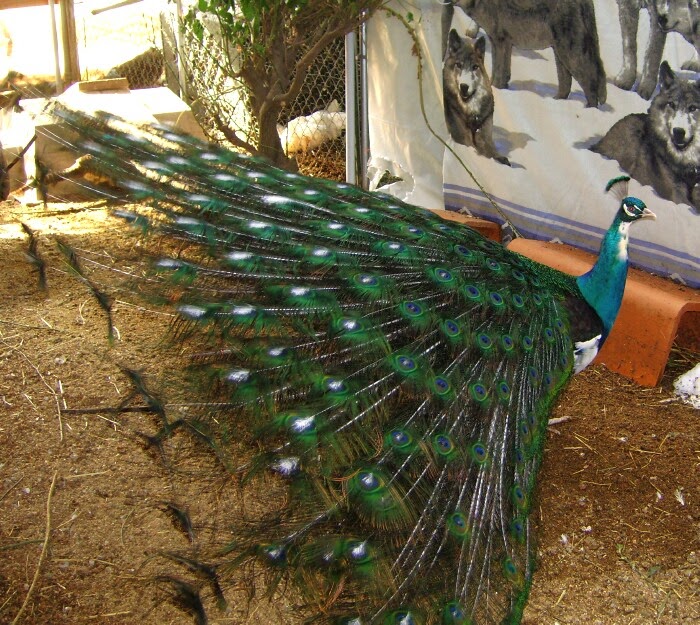
The landfowl I'm most interested in is, of course, the peafowl. I found out only recently that there are several different color forms of peafowl! I LOVE colors!


Now, I saw a Himalayan Monal today. Amazing colors!


I would like to raise the different birds, especially Phasianinaes, for their feathers. I can imagine all kinds of wonderful things that can be done with feathers like that, hats, jewelry, fashion (and flyfishing ;-))... and as these birds are basically just colorful hens, it's not any less ethical than raising chicken. The meat is good, the eggs are like hens' eggs.

So - what birds ARE there in the Phasianinaes group?

Genus Lophophorus
Gr. lophos crest; L. -fera -carrying

Himalayan Monal, Lophophorus impejanus
(It really does look like that...)

Sclater's Monal, Lophophorus sclateri

Chinese Monal, Lophophorus lhuysii

Genus Polyplectron, Peacock-Pheasants
Gr. polus, many, plektron, a cock's spur
Bronze-tailed Peacock-Pheasant, Polyplectron chalcurum

Mountain Peacock-Pheasant, Polyplectron inopinatum
Germain's Peacock-Pheasant, Polyplectron germaini
Grey Peacock-Pheasant, Polyplectron bicalcaratum
 The "eyes" of the plumage look almost black, colorless, but when the light hits them in right angle, they shine in amazing colors from purple and indigo to chartreuse green, depending on the angle.
Hainan Peacock-Pheasant, Polyplectron katsumatae
Malayan Peacock-Pheasant, Polyplectron malacense
Bornean Peacock-Pheasant, Polyplectron schleiermacheri
Palawan Peacock-Pheasant, Polyplectron emphanum

Palawan courting
Genus Rheinartia
Named after Lt.-Col. Pierre-Paul Rheinart (1840-1902)

Crested Argus, Rheinartia ocellata

Genus Argusianus
Argus or Argos was a 100-eyed giant, who guarded Io, and was slain by Mercury.
Hera transplanted his eyes after his death on the tail of a peacock.

Great Argus, Argusianus argus

Genus Pavo
 
Indian Peafowl Pavo cristatus

Green Peafowl, Pavo muticus

Genus Afropavo
Congo Peacock, Afropavo congensis

Tuesday, March 11, 2014

I want to get flexible

I have always wanted to be an acrobat, already when 5 years old. It’s one of my first memories of my life… me balancing on the back of a chair after having watched circus in television. It was an armchair, but still…

I want to be able to do yoga. I want to be able to turn myself into a pretzel. The meditation aspect of yoga, that I'm not interested in. But - I suppose it could have some positive effects in my life.

So - I want to get more flexible. What does that mean, then?

That I can do the splits. Right, left, center; front and back, up and down. 
There is a lot of tutorials, instructions and how-tos on-line, so that's not a problem. The problem is doing that, every dang day.
They say it takes two weeks to get from no-splits to splits... I doubt that, but... If I stretch faithfully every day, I will be two week CLOSER to splits than if I do nothing. And that's always something.

I want to be able to do the most advanced yoga positions.


And, really, I would like to be a contortionist. Do this:

And guess what? There are even sites teaching you how to become a contortionist on-line!

Introduction to practicing controtion
"However, it's important to do the exercises daily, even if you only do one hour each day (and around one hour is what you should begin with).
Loosing one day of exercising means that it can take up to one week to reach the same level of flexibility. The same is if you miss out a weeks exercises. It can take a month to reach the same level. So if you can't set aside some time each day to exercise don't start contortion training (and miss the best experience of your life)."

Monday, March 10, 2014

Using DIY.org to help you set steps

DIY is a site made to help kids reach their goals, make things, learn new things and experiment. So someone has already thought out a plan. It is build on the scout merit badge idea; you takes steps beginning from something simple, and as you finish the step challenges, you'll learn necessary skills to manage the further challenges.

For example; here's how to earn a filmmaker badge and here's how to earn an illustrator badge.


Thursday, March 6, 2014

Finding more time to do what you really want to do


How to accomplish anything in an hour a day: the magic hour method

So - where do you find that hour?

"But we all know that those hidden hours exist, buried in unnecessary meetings, inefficient work processes, interruptions, false starts, PowerPoint perfection, misplaced files, and a host of other time-wasters."
- Ron Ashkenas
Nearly everyone feels short on time and stressed out. But successful people have learned the secrets of time management and figured out how to invest their time for a good return, rather than spend it away. They know what’s really happening when we think we’re managing our time, and they have eliminated the worn-out feeling of not having enough time. Maybe most importantly, they know how to say “NO” to low-priority activities that put their goals on hold.

Here are 4 questions that will begin help you find more time immediately. These successful folks have asked themselves hard questions like:

    “How do I waste time?”
    “Do I spend enough time on activities that are truly important to me?”
    “What gets in the way of including those activities in my schedule?”
    “How can I stop wasting time and start investing it wisely?”

They have also asked themselves fun, dream-building questions like:

    “What activities could I devote time to that would fulfill me?”
    “How can I make more time for my priorities?”
    “If I had nine more weeks in every year, what would I do with them?”

How to find 3 extra hours EVERY DAY!
1 Get your sleeping under control.

Find your circadian rhythm, and follow it. Edison said that people don't need more than 3-4 hours sleep, but I have been sleeping for 6-7 hours a night for a couple of years now, and it's not working for me. I managed more when I was younger and actually slept at least 8 hours a night. 9 was even better. For Edison 3-4 hours worked, for me it's 8-9. How about you? Don't just guess, or believe Edison, or me, find out!

Find out if you have sleep apnea or some other problems that effect the quality of your sleep, and do something about it.

2 Most people get things done in the morning. If you are one of these people, get up earlier. And get up when you wake up.

3 prepare the night before as much as you can to make the next morning pass fluently. See that everything is packed and ready to just take with you; set the coffeemaker, take a shower, put your clothes ready... you get it.

4 Have a morning routine and evening routine. Give 15 minutes every morning and evening to the household, not only to brushing your teeth and taking a shower, but do the dishes, wash one machine of laundry, etc. etc.
It would, of course, be best if you could pay someone to keep your house, to get more time to do things you want to do, but that is not possible for most of us.

5 Owning things takes time from doing things. The less you have, the more you do.

6 Have a place to every thing, and keep the thing in that place. You won't be wasting time in looking for things, and cleaning goes faster.

7 Delegate and outsource. If someone else can do it, let them.

8 "method engineer" your chores. Catch the seconds wasted in inefficiency. How can you speed up your shower? How can you speed up your breakfast routines? Could you do the previous day's dishes as the coffee brews? Would you get faster to where you are going if you took the stairs instead of waiting for the elevator? What do you do during the elevator trip? How about the necessary movement from place A to place B? Commuting, driving to the supermarket, traveling?

Keep a diary of everything you do during the day, note every 15 minutes’ chunks of the day, like you were keeping a food diary. Write down what you do, how much time it takes/took, if you did many things or just one thing…
You need to know how you use your time to know how you could use it better.

There are two kinds of people from whom you can learn efficiency: very busy people and moderately fat people.
Busy people have no time to be wasted and MUST do several things at the same time. Fat people have the most effort efficient ways of doing everything. That's one of the reasons to why we are fat. You know the people who say they eat a lot but are really skinny? They are probably really fidgety, active and immediate people. Their way of doing things takes much more energy than the fat people's.

9 Another part of method engineering is evaluating the chores and skipping all that is not necessary. A lot of people do things just because they are used to do things in that way, not because it's necessary.

For example: in a factory they used 12 rivets to put something together. The method engineer wanted to see if they could do it using only 8 rivets. No.
9?`No.
10? Yes.
So - 2 rivets saved, and the time it took to put the rivets in place.

Do you iron your clothes? All clothes? You don't need to iron t-shirts and panties. Really. Or sheets. Stop that. Don't buy clothes that have special care requirements, like it must be dry-cleaned.

There was a test of some sort. A scientist came to a room full of children, and opened a jar after doing some unnecessary movements, like shaking the jar, tapping on it etc. Then he asked the kids to open the jar. If the kids were neuronormal, they did the same unnecessary movements as he had done. Neurodifferent kids just opened the jar without the unnecessary bits.

So - what are your "unnecessary movements"? Don't do things you don't need to do.

* WARNING *

There is one rather big risk when you start method engineering your life. Most of us cut off as unnecessary things kindness, consideration, politeness, decency, good manners, caring and loving, compassion, social convention... and that is not good. Human species is created to be social. The benefits of all this are much greater than any excess seconds spend in helping your neighbors and co-citizens. Also, by cultivating the relationships with other people, you get invaluable contacts that can help you reach your goals. Get friends. With all kinds of people. You never know how they can help you in the future. Never.

10 Make a meal plan and follow it.
You won't need to wonder what you'd eat. You have already decided and shopped the ingredients. That way you will save money and eat better, which gives you more energy. Also, if you are overweight, the chances are that by simply making a meal plan and shopping lists, you lose some weight. (Which gives you more energy.)
Get used to serial cooking, and freezing meals. (Serial cooking is making several dishes at a time, or after each other, that use the same ingredients, so that you can prepare for several meals at one go. Like frying minced meat or cooking several chickens at once. This way you can buy bigger packages of food, and most likely get it cheaper. If you are alone, cook every weekend and freeze the food in portions.)

11 Make shopping lists and follow them.
Do your grocery shopping only once or twice a week. Don't run to the shop just to buy one or two items. Do without, put them on the shopping list and adjust your plans to the missing items.
And eat before you go shopping. That way you spend less time and less money shopping.
Write your shopping list according to sections in the store. They keep most of the dairy in one place, and most of the meat, and baking items etc. Get familiar with how your usual grocery stores are organized, and make the shopping list so that you can just walk in, walk through the shop and walk out, without needing to run around and looking for things, and visit the same section several times.
Lift the items on the counter in the order you wish to pack them, and pack them according to where you put them in your home. That saves time in packing things in the store, and packing things up at home.
Have several reusable grocery bags, to save money and environment, and also to stop the accumulation of plastic and paper bags.

12 Effectify your wardrobe. Have a capsule wardrobe and the trimmings, where everything goes with everything else; looks good on you,; makes you feel good, and is functional and customized for your life style and needs. See that everything is clean and fixed, so that you can at any time just take some clothes and put them on you, and feel well dressed and nice looking all the time.
No more need to wonder and worry about what to wear

Also, stop using makeup. Most men don’t use makeup, ever, so why would women? It takes precious minutes to put it on, to keep it on and to take it off, minutes you could be using to something useful, something that takes you ahead on your plans.
Using makeup also takes money – you need to buy makeup, and it’s not cheap.
It takes up space. You could put something more useful in that space.
Especially if you travel!

And stop shaving. Having hair on your legs and armpits doesn’t effect your senses in any way. It doesn’t make you swim or bike faster, it doesn’t make it harder for you to do anything. It is 100% aesthetic thing, made to make women look like teenagers, girls, children, for their whole life. It’s aching to pedophilia, to be frank. It’s one of the ways the Western society binds women. You are to care about what other people think of you, you are to spend time and money and effort and other resources to shaving, in stead of using this time, money, effort and resources to something sensible, something you want, becoming more you, doing more, getting things done, reaching your goals…
Really!

13 Watch less TV. There MIGHT be some interesting and inspiring things on, but most of it is useless. Don't zap. Close the telly after you have seen the program you decided to watch.

One of the best ways of deciding what you really want to do is to ask you if you would spend the time for that if this was your last day on earth, or if this was the last day of your loved one. Would you, REALLY, rather see the nth episode of a tv drama than spend it with your loved ones? Really?

14 Spend less time on the internet.
You don't need to play any games on-line. Quit all of them. They are all waste of time. Really.
Commit to finish 10 pins on the pinterest before you pin anything more.
If you have more than 100 goals in your bucket list, commit to reach 2 goals before adding a new goal to the list.
Plan your blogging time, and keep the plan.
It would be best if you didn't spend any time at all on the internet, but spend it on doing things.

15 Take minutes from here and there.
Change a meeting from one hour to 45 minutes. Have meeting notes, and keep it short and relevant. If people want to discuss about the coffee, Sandy’s new kid etc. they can do it on their own time.
If you are prepared to give something a half an hour, cut it to 20 minutes.

16 Go through your plans. Which activities are actually beneficial to you and your plan, and which are just taking time from truly important stuff. I don’t know about you, but I get enthusiastically involved in things like discussing politics of another country, or the latest stupid thing a celebrity said, or finding an answer to a question, most often not even asked of me. The world is full of interesting things.
Also, we are often… not too nice, but nice in a wrong way. We easily promise to do this and that for people we like, even when we know we don’t really have the time, and especially when we don’t even know we don’t have the time.

17 Get a diary, planner, time manager, and use it.
Get really good at using it. Learn how to use it most effectively. Use color coding etc.
And use it.
Have a wall planner where you can put your meetings and dates on big, so that you are reminded of them in the morning without needing to waste any time of trying to remember.
Plan at least three days ahead. And follow the plan.

18 Chunk. Group similar tasks together, such as emails and calls. Set time for this, and put the timer on to stay focused.

19 Avoid distractions. Shut the phone, hang “do not disturb” sign on your locked door, put on ear muffs, do what ever it takes to see that you will not be disturbed, because a five minutes disturbance will eat up at least 15 minutes of your time, with the refocusing and all the other things that happen.

Stop multitasking, unless it’s something not important, but something that needs to be done. For example, brushing teeth and reading. Making food and doing the dishes. You can also read the newspaper at the same time. None of those jobs demand full focus and concentration, so there you can multitask.
Finding time to do all you want to do

"They taught us in the fable of the tortoise and the hare so early, most of us dismissed it as a children’s tale and ignored the powerful lesson it contains: Others may be brighter. Others may learn quicker and retain more. Yet whosoever keeps on plodding relentlessly toward the goal of mastering another language, though his gifts be dim, stands a better chance than the unmotivated genius whose dazzle ignited so much envy in high school Spanish class.

Harnessing your hidden moments, those otherwise meaningless scraps of time you’d normally never think of putting to any practical use, and using them for language study – even if it’s no more than fifteen, ten, or five seconds at a time – can turn you into a triumphant tortoise.
---

---
Hidden moments will heal your deficiencies soon enough, but first let’s talk about the unhidden moments, the study time you’ve arranged to commit to your endeavour.

This book is written for those who can’t or don’t want to expend the time or money required to attend formal classes. Successful self teaching is our objective.
If you can take a whole hour every day and devote it to your studies, you’re in excellent position to make satisfying, even dramatic, progress.
If you can devote a half hour a day, you’re still poised for success.
If you can’t commit a regular block of time, if the best you can do is an hour here, a half hour there, and maybe a three hour block of time over the weekend, that’s satisfactory, provided you keep it up and maintain momentum.

Gardens unattained go to weed. Apples bitten into and abandoned turn brown. Likewise, your collection of language data – words, phrases, rules, and idioms – will dissolve into a useless mass if not kept up.

Apportion as much time as you reasonably can and as regularly as you can, and then enjoy the magic as the hidden moments kick in.

A professional financial advisor on radio once urged people to take careful inventory of their financial assets, promising that overlooked and forgotten riches were to be revealed at every hand. Her credibility disappeared for me at that moment. I honestly think I’ve never been at a point in my economic life where I was likely to underestimate my holdings by as much as seventy-five cents! When it comes to time, however, that’s a much more lucrative matter!

You can learn a language in twelve months using only those moments you didn’t realise you had.

We’ve already mentioned a few corners in which hidden moments lurk awaiting liberation. Let’s review them and add some more.
Moments we instinctively bid goodbyes to include those spent waiting for and riding in elevators, waiting for the person you’re dialing to answer, waiting while he puts you on hold, waiting for a long outgoing message from someone’s answering machine to reach its conclusion. There are those moments when you’re helplessly trapped – when someone who’s too good a friend to hang up on delivers an unending narrative requiring no verbal participation on your part beyond an occasional grunt, groan, “dear me,” “gee whiz,” or other appropriate interjection to let him know you’re still there. It’s usually safe to divert some of your attention from your friend to your flash cards. There’s a major payload of hidden moments right there, and we haven’t even gone beyond the elevator and the telephone!
We can take time back from our days just like the Dutch took land back from the sea and put it to work.
What do you normally do when you’re waiting in line at the bank, the post office, the airline counter, the bus or train station, or the supermarket checkout counter?
What do you do while you brush your teeth? You could be listening to a language cassette.
What plans have you made for the time you’re going to spend waiting behind your steering wheel at the gas pump? Or waiting for the rinse cycle? Waiting for the school bus?
You get the point. An honest, thorough scrutiny of your normal week will yield dozens, even hundreds, of minutes that can be put to work learning your target language.
And don’t forget, a scrap of time need be no longer than five seconds to advance you closer to your goal.
---

---
Get your cassettes into action when you wake up, stretch, make the bed, fix breakfast, brush teeth, dry off after a bath or shower, wash dishes, and so on through all the moments when those less ambitious turn on the radio or TV.
Don’t forget, passive listening is better than nothing, but not by much! Engage the English mentally and try to beat the voice on the cassette to the foreign word.

“Harnessing hidden moments” is a three word course in language learning all by itself. It offers a side benefit that has nothing to do with learning languages but has a lot to do with enjoying life.
Look at those other people, those unfortunates who, unlike you, have no intention of harnessing their hidden moments to learn languages or anything else. Look how they wait like zombies in line, their faces masks of boredom and pain. Your boredom and pain will vanish the instant you get into line and whip out your flash cards.

Learning languages can become incidental to daily life. It’s often fulfilling enough just having something useful to do! Remember what Dean Martin said to the slowly sipping starlet: “I spill more than you drink!” Just by using the minutes you’d otherwise spill, you can learn another language. "

- How to Learn Any Language by Barry M. Farber
Here's some other "time tricks", that will help you find the time you need to do all the things you want to do:

Time Tricks to Get More Done

* 2-minute trick (if it takes only 2 minutes or less to do, do it NOW.)
* pomodoro (set a timer to 15 or 25 minutes, work through that time, then have a 5-10 minutes' break, and continue until the work is done)
* find your best time to work - Find out your personal circadian rhythm, and let it work for you by actually going to bed and getting up according to your personal preferences, and planning to work and rest according to your circadian rhythm.


Learning to Learn: leveraging your circadian rhythm
It really is that easy. You listen to your body and believe it. You KNOW if you are a morning person or an evening person. You KNOW when you feel most alert and when you are feeling tired, when you feel energetic and when you feel lazy and sluggish. You know. You just need to listen to your body and feelings, and not what you assume the society and people around you EXPECT you to be and function. In our society morning people are preferred and the society is build to fit their circadian rhythm, but the morning people are not a majority in the society. To get the most out of yourself you MUST find your own circadian rhythm and adjust your activities to it. Not the other way around.

Circadian Rhythm – Getting Back On Track

Leonardo Da Vinci’s Top Six Tips for Getting Things Done

Wednesday, March 5, 2014

Become a herbalist

What I mean with "herbalist" is knowing about the qualities and properties of the wild plants around me, knowing about herbs and garden plants in my garden, being able to use the plant world, both wild and domestic, as food, medicine and for other purposes.


I'm not too interested in becoming a professional, registered herbalist. I just want to be able to herbal a little for my own needs and purposes. Also, as I am a witch, I want to know about the magical properties of herbs.

How do I plan doing that?
Just studying. Take my herb books and learn them by heart, learn to recognize all the plants in my environment, have a herb garden, forage and make food and potions of the herbs.

I plan learning 10 plants in a week.

I'll start 1/5 and finish 23/9. That gives me almost exactly 21 weeks. (1st is thursday and 23rd a tuesday), so in the end of summer 2014 I'll know 210 plants and their use, and have actually used them all, not just "know", but KNOW them.
And I want to learn to know the use of LOCAL plants and herbs.
You know, like 100 species challenge

I will have a herb journal, where I write notes... it would be nice if I could be bothered to also illustrate the journal, by drawing, photos or pressed plants.

I plan writing in the journal the 10 plants for the week on previous Sunday, finding the information of use, some recipes to try, and then spend the next week hunting the plants and cooking and experimenting.

Tuesday, March 4, 2014

Write the itinerary to your dream

When you set a date to a dream, it becomes a goal.
When you break the road that will take you to the goal into steps, it becomes a plan.
When you take the steps of the itinerary, you make your dreams come true...


"Goals give you passion, purpose, motivation, and drive. You wake up each day with intention: you have a plan and you have direction."

There is a lot of help on-line to help you reach the goals of your life.

1) think about it. Think about your priorities, your heart's desire, what you really want. Because if you don't really want to reach the goal, you won't take the steps either. This is why your core values are important. You need to know them, and do things remembering them, because of them, to express them, to change the world in accordance to them. Otherwise you won't be happy, you won't be working to reach the goal, because deep down you KNOW you don't really want to reach the goal...

Where do you want to be, what do you want to be, where do you want to have been, what do you want to have done in a year from now?

2) choose just a couple of goals to work on at a time.

Write them down, and be VERY SPECIFIC when you do that.

What do you want to accomplish?
Whom do you need to be able to accomplish it?
When do you want to accomplish it? What's the pace?
Where do you want to accomplish this? Where does it need to happen?
Why do you want to accomplish it? What are the reasons behind it, what is the purpose of this dream, what do you expect to reach, to get, what's the benefit of reaching this goal?
Which requirements, which tools, which constraints?
How do you plan to accomplish it?

This reminds me of the Celtic Cross tarot spread.
First you put down a card that stands for you. The core values. Who are you?
Then you put a card over you. This card stands for what covers you, what is going on in your mind, what is the theme of your life right now.
Next comes a card that crosses you, like a bond or a bar. This card symbolises the obstacles in the situation, contrary elements, source of resistance, balancing tendency, factor for change, unexpected events, what's rocking the boat, opposing factors.
Then comes four cards around this pile of cards in the middle.
One is beneath you, that is the ground that you stand on, the foundation of the situation. The hidden influences, the starting point, deeper meanings etc.
One is behind you; that the step you just took, your immediate past. All the factors that has to do with the situation, that have been resolved, all the concerns that lead to this point that are no longer of any concern, things that have been taken care of, things you don't need to think any more.
One crowns you. This card tells about the "birds that have built a nest over your head". It's a picture of the current situation.
One is before you. This card is about the very next step on your road, the immediate future, all the factors that have to do with the situation, that have not been resolved, concerns to be concerned, things to be taken care of, things you need to think next.
So create a "tarot spread" of your dream.

3) Time management

How much time you have to invest?
Just 20-30 minutes a day is enough to do SOMETHING.

4) Make yourself accountable.

It would be nice if you had a friend or anyone whom you could tell about your plan and ask him/her to keep track on your advancement. It is best if that someone is close enough to make you reward or punish yourself in the agreed manner, and do it in a supportive manner. :-D

Think about the things you appreciate in life, and reward yourself for each step you manage to take on the road to your goal.
You can either pamper yourself with a home spa night, or movie night, you can allow yourself to eat dessert, you can pay yourself for each step. What ever rocks your boat.

Think about the things you find hard to do, and use them to punish yourself for each step you fail to take.
You can for example deny yourself the dessert, put some penalty money in a jar, call your irritating aunt, clean something not urgent, but something that would be good to get cleaned. Or "give me twenty". :-D
That way there's some sense and reward even in the punishment.

5) Make your plan so visible you can't avoid seeing it.
Frame it over your bed so that it's the first thing you'll see in the morning and the last thing you'll see before falling to sleep.
Have a copy in your bathroom, so that you see it every time you use the bathroom.
Have it on the fridge door, or the door of the cupboard where you store your morning coffee. A place you can't avoid seeing several times a day.
Tape it on your television. In stead of zapping or watching that show you're really not interested in, do something to help you reach your goal.